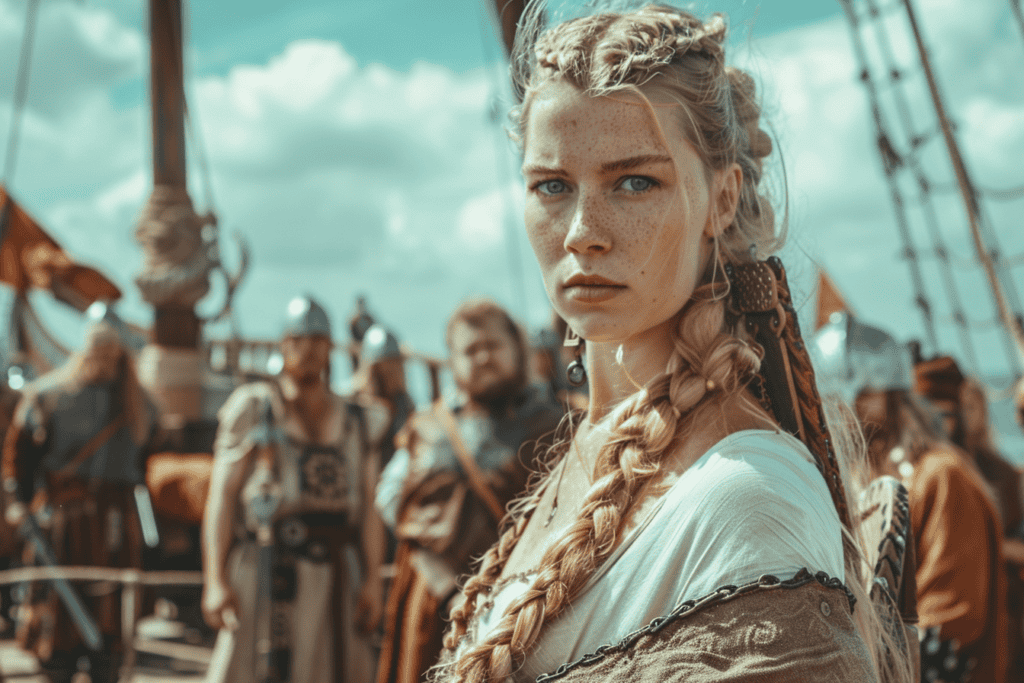
Remembrance of Unnr the Deep-Minded
Unnr the Deep-Minded was one of the great settlers of Iceland — a widowed matriarch who built a ship in secret, carried her people west, and made herself a lord where there were none. We remember her as a foremother of the tradition: the line she founded kept and copied the very sagas we now reconstruct from.
How it’s observed: A small ancestor-blót and a minni raised over the horn — honoring her foresight and provident leadership, and the debt owed to the bloodline that carried the old words down.
History & Lore
Who she was
Unnr the Deep-Minded was one of the great settlers of Iceland, and one of the most formidable figures — of any sex — in the whole settlement age (landnám, late 9th century). Her byname, djúpúðga, means deeply wise, far-seeing, sound in counsel. It is an epithet earned, not inherited, and the sagas spend their pages proving she deserved it.
She was a daughter of Ketill Flatnose (Ketill flatnefr), a Norwegian hersir who had carved out lordship in the Hebrides during the westward Viking expansion — so she was born into displaced Norse aristocracy, raised on the sea-roads between Norway, the Isles, and Ireland. She married Olaf the White (Óláfr hvíti), the Viking king of Dublin, and bore him a son, Thorstein the Red (Þorsteinn rauðr), who grew into a war-leader and conquered a broad swathe of northern Scotland before he was killed in battle.
(A note for the record: the sources can’t settle her first name. Laxdæla saga calls her Unnr; Landnámabók and Eyrbyggja saga call her Auðr. Scholars treat them as one woman — the name simply drifted between compilations.)
What she did
Within a short span she lost her husband and then her son, leaving her a widow and a war-orphaned matriarch in hostile territory, with a following to protect and no man to shelter behind. A lesser figure would have been absorbed into someone else’s household on someone else’s terms. Unnr did the opposite.
She had an ocean-going ship built in secret, in a forest — the detail the saga lingers on, because it announces exactly what kind of mind she had: patient, covert, decisive. When it was ready she loaded her surviving kin, her followers, and her freedmen, and sailed west out of Scotland ahead of the danger. She stopped at Orkney and the Faroe Islands along the way, marrying granddaughters into both to plant her line and forge alliances, then made for Iceland.
There she claimed a great territory around Breiðafjörður in the Dales, settling at Hvammur — and she claimed it in her own right, one of only a handful of women to hold land as a founding settler. Then she gave much of it away, portioning it out to her men and her freed slaves with an open hand, exactly as a founding chieftain would. She did not merely survive the crossing. She arrived and made herself a lord.
She was also a Christian, baptized before Iceland’s conversion, and she raised crosses at a height near her home called Krosshólar — “Cross Hills” — where she went to pray.
Her death
The sagas give her one of the finest deaths in the entire corpus. She arranged the marriage of her grandson and chosen heir, Olaf Feilan, and held a great wedding feast to publicly settle her succession. She presided over it with full composure, formally handed her authority to the next generation, and told her guests to enjoy the hall. She then retired to her bed, and was found to have passed away the next morning, sitting upright, gone at the exact moment her affairs were perfectly in order. Several accounts give her a ship burial, laid to rest with treasure. Whe contrast against the deeds of her life, the sagas show that this was a death of her chosing, on her terms, despite the tradgey and challanges she faced in life.
Why she matters to me
There are two reasons, and the second strikes deep at the heart of why we give thanks to our ancestors.
First: As a role model. Her byname is a virtue. Djúpúðga — depth of mind, the foresight to see a storm before it breaks and the resolve to act while there is still time to act; not just for herself, but for her community. She embodies the pairing of provident foresight and decisive will almost perfectly. She built the ship before she needed it, moved before she was trapped (or worse), settled her people, ordered her house, and laid herself down on her own terms. For anyone building a life on warrior virtue, she is a clean example of what wisdom looks like when it is practical; wisdom that ends with a well-run hall and a good death, not just ffancy words and flourish.
Second: As a foremother of the tradition. Here is the thread of fate that makes her ours despite her spiritual beliefs. Her Christianity did not hold past her own generation. Her descendants reverted into old pagan ways, and in that very family the custom grew up that the dead went into the hills; the Christian foremother’s prayer-site became a heathen ancestor-barrow within three generations. And it was that line, reverted to blót, that eventually kept and copied the eddas and sagas we have today. The material we reconstruct our beliefs from flowed through her. Her foresight put her people on that shore, and her heathen great-descendants are the reason the old words were written down at all. We honor her for the debt we owe her wisdom and forsight that we can never repay.
That is the spirit of ancestor-honor. It was never about shared doctrine, as each of us write follow our own unique path through this world. It is about giving thanks to the past that formed our present and the recognition that we are now the tortchbearers for those who come after we are gone. We pour to the ones we stand on top of, regardless of what gods they kept.
The Rite
A small solitary blót to honor Unnr as a foremother — one whose wyrd is woven into your own.
Because her thread crosses yours, this is an ancestor-rite rather than a rite to the gods: you are not asking a power for a boon so much as acknowledging a contribution, tending a bond, and drawing a strand of her wyrd, her foresight and her provident resolve, into your own weaving. Keep it small. It is meant to be spoken by one person, over one horn.
You will need
A horn or cup, and drink worthy of a matriarch. I prefer mead or ale.
A blótbolli (offering bowl) to receive her portion, or open earth if you are outdoors.
A flame candle or a small fire in memory of Krosshólar, the height where she went to pray. If you can hold the rite outdoors and on high ground, so much the better.
Her name, spoken or written, and if you wish, a token of the tradition she carried: a copy of the Poetic Edda, or Laxdæla saga itself.
The observance
Hallow the space. Set the ground apart as you normally do, by the Hammer, by fire carried around the stead, or by a plain hallowing-word. You are marking a boundary between ordinary time and this remembrance, not asking her to be anything other than who she was.
Kindle the flame. Light the candle or fire and speak her into the space:
*Unnr, Ketil’s daughter, Deep-Minded, I call you.
Foremother, ship-builder, land-giver —
across the whale-road and across the years,
your thread crosses mine. I remember you.*
Name the debt. Say, in your own words, why you have come: that the words you build your practice from came west in her keeping, that the line she carried kept the old ways alive, and that you stand today on ground she reached first. Speak plainly. She was a woman of few illusions.
Fill the horn and raise the minni. Charge the horn and speak the memory-toast (below), or one of your own design. Then drink, take her memory into yourself.
Give the gift. Pour what remains into the bowl, or onto the earth if you are outside. This is gjǫf við gjǫf, a gift for a gift. She gave land with an open hand; you give back the first and best of the horn. Say:
As you gave, so I give. Take this, foremother, and be honored.
Sit in her silence. She was the Deep-Minded. Sit for a moment in stillness before the flame and simply listen. Ask, if you like, for a measure of her foresight in some matter of your own life, some house you need to set in order. Receive whatever comes, or nothing, without grasping.
Close. Thank her, and let her go:
*Well-remembered, Unnr Deep-Minded. Go with honor.
Until the wheel comes round again, hail and farewell.*
Extinguish or bank the flame. If you gathered the offering in a bowl indoors, carry it out to the earth afterward; ideally to high or open ground.
One act in her honor
A rite is completed by a deed. In the days around the 9th, do one thing that is properly hers: settle something you have been putting off, put some corner of your own house in order, make one provident decision you have been avoiding. She built a ship and moved her people away from the encroaching storm. Honor her by seeing your own storm early and building.
Words & Toasts
The remembrance is carried in the minni — the memory-toast raised over the horn. If you keep a small sumbel, whether alone or with others, let this be the round for her. In a fuller sumbel of three rounds, she belongs in the second: the round of the ancestors and the honored dead.
The full minni
To Unnr the Deep-Minded — Ketil’s daughter, who saw the storm before it broke uppon her people. She built her ship in the shelter of the trees and carried her people over the whale’s grey road to a land that had no lords until she made one of herself. She gave earth to her freedmen with an open hand, set her house in order, married her heirs well, and lay down at the height of her own feast — a death chosen, not suffered, a life lived with intent as an example for her ancestors. She did not pray to our our gods. But the blood she bore west became the blood that kept the old words breathing, and out of her line came the hands that wrote them down. For a debt we cannot repay, we remember her. Hail Unnr, Deep-Minded, mother of the saga-keepers. Hail!
The short form
For a clean raise of the cup, when the long words aren’t wanted:
To Unnr the Deep-Minded — who saw far, led well, and died on her own terms. She was not ours, but through her line the old words survived. Hail Unnr, mother of the saga-keepers!
If you hold a full sumbel
Frame three rounds and place her in the second:
- First round — to the gods. Raise the horn to whichever gods you wish to honor.
- Second round — to the ancestors and honored dead. Raise the minni above (or one of your own design) to Unnr, and to any of your own foremothers and forefathers you wish to name beside her. This is her round.
- Third round — a free round. Boasts, oaths, or a memory of your own choosing — often a vow made in her spirit: some provident thing you will set right before the year turns.
Notes on Pronunciation
Respellings lean toward the Old Norse values (closer to the reconstruction era); the few sharp modern-Icelandic divergences are flagged. Stress always falls on the first syllable. Click a speaker to hear it.
Key to the letters
- Þ / þ (thorn) — hard th as in thin
- Ð / ð (eth) — soft th as in this (voiced; never starts a word)
- Á / á — long “ah” in Old Norse; “ow” (as in cow) in modern Icelandic
- Æ / æ — long “eh/ae” in Old Norse; “eye” in modern Icelandic
- Ó / ó — “oh”; Ú / ú — “oo”; Í / í — “ee”
- Ý / ý — like German ü (round your lips and say “ee”)
- Ö / ǫ — rounded “aw/uh,” like the vowel in bird without the r
- ei / ey — “ay” as in day; au — “ow” in Old Norse (“öy” in modern Icelandic)
- hv — “hw” (like where) in Old Norse; “kv” in modern Icelandic
- ll — a long “l” in Old Norse; often “tl/dl” in modern Icelandic
Names & terms
- Unnr — OON-r — the woman herself (u as in pull, roll the final r)
- djúpúðga — DYOOP-ooth-ga — “the Deep-Minded” (voiced th)
- Auðr — OWTH-r — her alternate name (voiced th)
- Ketilsdóttir — KET-ils-DOH-tir — “Ketill’s daughter”
- Ketill Flatnefr — KET-ill FLAT-nevr — Ketill “Flat-nose” (f → “v”)
- Óláfr hvíti — OH-lahv-r HWEE-ti — Olaf “the White” (modern: KVEE-ti)
- Þorsteinn rauðr — THOR-stayn ROWTH-r — Thorstein “the Red”
- Óláfr feilan — OH-lahv-r FAY-lan — Olaf Feilan, her heir
- Laxdæla saga — LAX-dye-la SAH-ga — (Old Norse: LAX-deh-la)
- Landnámabók — LAND-nah-ma-bohk — “Book of Settlements” (modern: -NOW-ma-)
- Eyrbyggja saga — AYR-big-ya SAH-ga — a source saga
- Breiðafjörður — BRAY-tha-FYUR-thur — “Broad Fjord,” her region
- Hvammur — HWAM-mur — her homestead (modern: KVAM-mur)
- Krosshólar — KROSS-HOH-lar — “Cross Hills,” her prayer-height
- hersir — HER-sir — a local chieftain/lord
- landnám — LAND-nahm — the settlement age / “land-taking”
- blót — bloht — a sacrificial offering-rite
- blótbolli — BLOHT-bol-li — the offering bowl
- sumbel — SUM-bel — the ritual drinking-rite (ON sumbl)
- minni — MIN-ni — a memory-toast to the dead
- gjǫf við gjǫf — GYAWV vith GYAWV — “a gift for a gift”
Personal Notes
(Your own reflections, additions from your studies, and how you kept the day.)
Sources for the History & Lore: Laxdæla saga (chs. 1–7), Landnámabók, and Eyrbyggja saga. As with all the settlement sagas, these were written down two to three centuries after the events and shaped as literature as much as record — but her existence and her role as a founding settler are attested across all three, which is about as firm as settlement-era memory gets.
← back to Pagan Holidays