Runes
 Casting the Runes: Merkstave & the Marked Stone
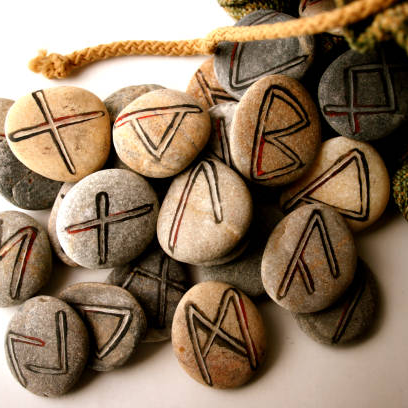
A note on what is old and what is new Honesty first, as everywhere on this site: casting lots is anciently attested — Tacitus, writing of the Germanic tribes in the first century, describes marked …
- Fehu (ᚠ)
Pronunciation: FAY-hoo · Latin equivalent: F · Freyr’s ætt, first rune Name and meaning Proto-Germanic fehu, “cattle” — and therefore wealth, in a world where the herd was the bank …
- Uruz (ᚢ)
Pronunciation: OO-rooz · Latin equivalent: U · Freyr’s ætt, second rune Name and meaning Proto-Germanic ūruz, the aurochs — the wild ox of northern Europe, hunted to extinction in the 1600s. The …
- Thurisaz (ᚦ)
Pronunciation: THUR-ih-sahz · Latin equivalent: TH (þ) · Freyr’s ætt, third rune Name and meaning Proto-Germanic þurisaz, “giant” — the þurs, the jötunn as raw hostile force. The …
- Ansuz (ᚨ)
Pronunciation: AHN-sooz · Latin equivalent: A · Freyr’s ætt, fourth rune Name and meaning Proto-Germanic ansuz, “a god” — one of the Æsir, and by long association the Allfather …
- Raidho (ᚱ)
Pronunciation: RYE-thoh · Latin equivalent: R · Freyr’s ætt, fifth rune Name and meaning Proto-Germanic raidō, “riding; the wagon” — the journey and the vehicle at once. The old …
- Kenaz (ᚲ)
Pronunciation: KEN-ahz · Latin equivalent: K · Freyr’s ætt, sixth rune Name and meaning Two names survive for this rune, and they could hardly differ more. The Anglo-Saxon poem’s cēn is …
- Gebo (ᚷ)
Pronunciation: GEB-oh · Latin equivalent: G · Freyr’s ætt, seventh rune Name and meaning Proto-Germanic gebō, “gift” — and in the old North a gift was never only a kindness. It was a …
- Wunjo (ᚹ)
Pronunciation: WOON-yoh · Latin equivalent: W / V · Freyr’s ætt, eighth rune Name and meaning Proto-Germanic wunjō, “joy” — not giddiness but the deep contentment of enough: …
- Hagalaz (ᚺ)
Pronunciation: HAH-gah-lahz · Latin equivalent: H · Heimdall’s ætt, first rune Name and meaning Proto-Germanic haglaz, “hail” — the sky’s cold grain. The second ætt opens with …
- Nauthiz (ᚾ)
Pronunciation: NOW-theez · Latin equivalent: N · Heimdall’s ætt, second rune Name and meaning Proto-Germanic naudiz, “need” — necessity as constraint, the tight place. The old …
- Isa (ᛁ)
Pronunciation: EE-sah · Latin equivalent: I · Heimdall’s ætt, third rune Name and meaning Proto-Germanic īsaz, “ice” — the single upright stroke, simplest of all the staves. Ice in …
- Jera (ᛃ)
Pronunciation: YAIR-ah · Latin equivalent: J / Y · Heimdall’s ætt, fourth rune Name and meaning Proto-Germanic jēra, “year” — and specifically the good year: the harvest. The rune of …
- Eihwaz (ᛇ)
Pronunciation: AY-wahz · Latin equivalent: EI · Heimdall’s ætt, fifth rune Name and meaning Proto-Germanic īhwaz, the yew — the graveyard tree, the bow-wood, evergreen and patient, poisonous and …
- Perthro (ᛈ)
Pronunciation: PER-throh · Latin equivalent: P · Heimdall’s ætt, sixth rune Name and meaning Proto-Germanic perþō — and here honesty requires a shrug: nobody knows what the word meant. The shape …
- Algiz (ᛉ)
Pronunciation: AL-geez · Latin equivalent: Z · Heimdall’s ætt, seventh rune Name and meaning Proto-Germanic algiz, “elk” — by way of the Anglo-Saxon poem’s eolh-secg, the …
- Sowilo (ᛊ)
Pronunciation: so-WEE-loh · Latin equivalent: S · Heimdall’s ætt, eighth rune Name and meaning Proto-Germanic sōwilō, “sun” — in the North not a scorcher but a rescuer: the light …
- Tiwaz (ᛏ)
Pronunciation: TEE-wahz · Latin equivalent: T · Týr’s ætt, first rune Name and meaning Proto-Germanic tīwaz — the god Týr himself, the rune an arrow aimed at heaven. Týr is the god who laid his …
- Berkano (ᛒ)
Pronunciation: BAIR-kah-noh · Latin equivalent: B · Týr’s ætt, second rune Name and meaning Proto-Germanic berkanan, “birch” — first tree into scorched or cleared ground, …
- Ehwaz (ᛖ)
Pronunciation: EH-wahz · Latin equivalent: E · Týr’s ætt, third rune Name and meaning Proto-Germanic ehwaz, “horse” — and in the old world the horse was the partnership: sacred to …
- Mannaz (ᛗ)
Pronunciation: MAH-nahz · Latin equivalent: M · Týr’s ætt, fourth rune Name and meaning Proto-Germanic mannaz, “human being” — not the individual alone but humankind: the self as it …
- Laguz (ᛚ)
Pronunciation: LAH-gooz · Latin equivalent: L · Týr’s ætt, fifth rune Name and meaning Proto-Germanic laguz, “water; lake” — the sea-road and the depth beneath it. Water in the Norse …
- Ingwaz (ᛜ)
Pronunciation: ING-wahz · Latin equivalent: NG · Týr’s ætt, sixth rune Name and meaning Proto-Germanic ingwaz — the god Ing, whom the lore knows better as Freyr (Yngvi-Freyr, ancestor of the …
- Dagaz (ᛞ)
Pronunciation: DAH-gahz · Latin equivalent: D · Týr’s ætt, seventh rune Name and meaning Proto-Germanic dagaz, “day” — but truly the daybreak: the hinge where night becomes morning. …
- Othala (ᛟ)
Pronunciation: OH-thah-lah · Latin equivalent: O · Týr’s ætt, eighth rune Name and meaning Proto-Germanic ōþalan, “inherited estate” — the odal land: the homestead held in a family …