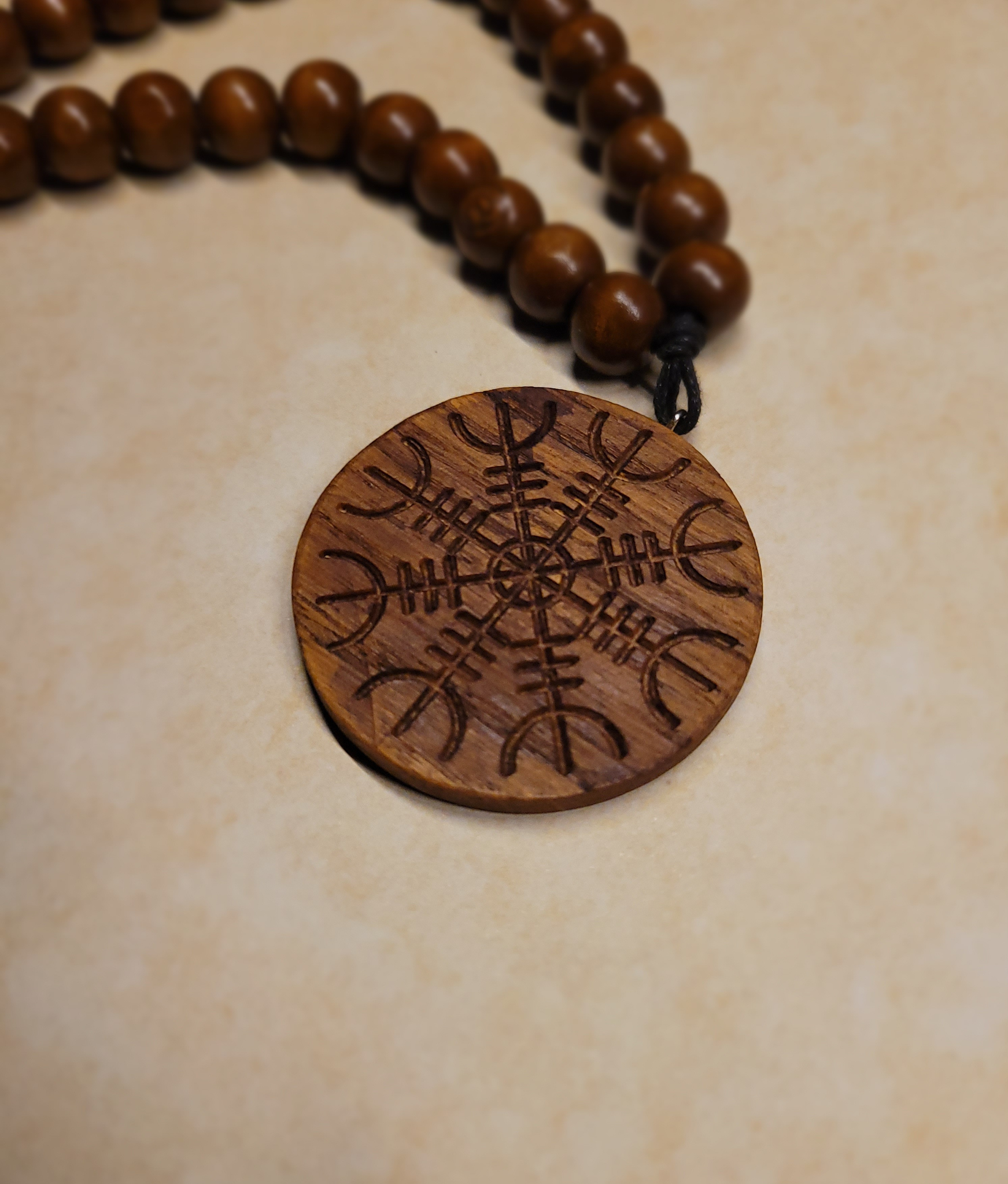
Ægishjálmur (The Helm of Awe)
Pronunciation: EYE-gis-HYOWL-mur
Name and etymology
Ægishjálmur (Old Norse ægishjálmr) joins ægir, “terror” or “awe,” with hjálmr, “helm” or “covering” — the helm of terror, the covering of awe. A note to spare you a common confusion: the ægir here is the ordinary noun for dread, not the sea-jötunn Ægir who hosts the gods’ feast in Lokasenna. The two words are lookalikes, and the sea giant has nothing to do with this symbol.
The name matters more than usual for this entry, because Ægishjálmur is the rare symbol where the name and the image have two different birthdays. The helm of awe as a named thing of power is genuinely ancient as it appears in the Poetic Edda itself. The eight-armed stave that carries the name today is not.
Understanding this symbol honestly means holding both of those facts at once, and it turns out the tradition is richer for it.
Textual sources
The helm of awe enters the record in the Fáfnismál of the Poetic Edda, in the mouth of a dragon. Sigurd has dealt Fáfnir his death-wound, and the dying dragon and the young hero hold one of the strangest and most compelling conversations in the whole corpus. Fáfnir, accounting for his long reign of fear over the land, says he bore the ægishjálmr over all people while he lay upon his gold, blowing poison in every direction so that none dared approach (st. 16).
Sigurd’s reply is the single most important sentence ever spoken about this symbol, and it comes from inside the tradition itself: the helm of awe, he tells the dragon, protects no one — not when brave men come to fight (st. 17). Courage, the poem says flatly, defeats terror. We’ll come back to that.
In the prose following the poem, Sigurd takes the ægishjálmr from Fáfnir’s hoard along with the gold. There it reads as a physical treasure, an object of power among other objects. The Völsunga saga, retelling the same material, likewise counts the helm among the marvels Fáfnir possessed. Beyond the Sigurd cycle, Old Norse literature uses “to bear the helm of awe over someone” as an idiom for dominating them through fear; evidence that the concept was live enough in the culture to work as a figure of speech.
What none of these sources contains is a picture. The Eddic ægishjálmr is a named power, perhaps an object, perhaps a quality projected from its bearer. However, no medieval source draws it, and no Viking Age artifact depicts it.
The eight-armed stave belongs to the same tradition that gave us Vegvísir: the Icelandic staff of the early modern charm-books. Helm of awe staves appear in the Galdrabók, the oldest surviving Icelandic grimoire, compiled around 1600, some in simpler forms than the familiar design, and the classic radial figure, eight trident-tipped arms spreading from a central point, is attested across manuscripts of the seventeenth century and later. The charm instructions are wonderfully concrete about where the symbol lives. It is to be marked on the forehead, between the brows. One later Icelandic charm has its speaker declare outright, “the helm of awe I bear between my brows.” Wherever else the symbol has traveled since, its traditional seat is the space just above the bearer’s eyes — worn facing the world.
So, the honest genealogy runs: an Eddic name and power, carried through centuries of Icelandic magical practice, given its visual form by early modern charm-workers drawing on their own inheritance. Not a Viking Age drawing, and not a modern invention either. A living tradition, doing what living traditions do: extending the old material into new forms and, in the manuscripts, honestly showing its work.
Reading the symbol
The design is usually read through its parts: eight arms radiating from a single center, each ending in a trident-like fork, often crossed by pairs of lines along their length. The radial form projects outward in every direction at once — protection with no undefended side — while the center point marks the bearer, the fixed self from which the defense radiates. The arms are commonly seen as elaborated from the rune Algiz (ᛉ), the elk-sedge rune long associated with protection, though as with all galdrastafir the construction logic went unrecorded and such readings are reasonable inference rather than documented design.
In modern practice, Ægishjálmur is carried to invoke protection. A shield against physical and spiritual harm; to enhance courage; overcoming fear and doubt; and to assert strength, steadiness and authority in confrontation and leadership. It appears in amulets, talismans, and tattoo work, and practitioners meditate on it or visualize it between the brows for empowerment and defense against negativity. The charm-books’ own placement, still in use four centuries on.
It is interesting to notice what modern bearers have done with the symbol’s meaning, because I think it’s one of the quiet triumphsj. Almost nobody today carries the Helm of Awe for Fáfnir’s purpose. The dragon used it to terrorize; to dominate a land into keeping its distance. The modern readings are about not being dominated: courage over fear, protection rather than predation, the strength to stand rather than the power to terrify. Somewhere across the centuries, the tradition took the helm off the dragon and handed it to Sigurd.
A personal reading: the helm that didn’t save the dragon
Stay with the scene where the symbol is born, because the Edda has already done the moral analysis for us.
Fáfnir is the tradition’s great case study in what terror-as-armor actually buys. He began as no dragon at all — he was a son of Hreiðmarr who murdered his own father for gold and then lay upon the hoard so long, in such jealous dread of losing it, that he became the monster. The helm of awe was his instrument of choice. Project enough fear and no one can ever get close enough to take what’s yours. And it worked, in the way such strategies work. He kept the gold. He also spent his existence alone on a barren heath, trusted by no one, loved by no one, poisoning the ground he lay on; until a young man with more courage than fear crawled into a ditch and put a sword through the one side terror never covers.
Then comes the exchange that should be stamped on every Ægishjálmur pendant ever sold. The dragon boasts that the helm of awe made all people fear him. And Sigurd — respectfully, almost gently, speaking to a dying creature — corrects him. The helm of terror protects no one, when the brave come to fight. Fear only governs the fearful. Against a person who has mastered their own fear, the entire strategy evaporates. The poem does not present this as Sigurd’s opinion. It presents it as what just happened.
Here is what I take from carrying that scene alongside the symbol. There are two ways to wear a helm of awe, and they correspond to the two figures in the ditch. Fáfnir’s way points it outward: intimidation as a substitute for strength, the projection of dread to keep the world at arm’s length, and the poem’s verdict on that way is a corpse on a heath. Sigurd’s way is the one the modern tradition has, rightly, chosen. The helm worn between the brows as mastery of the fear behind them. Not “be feared.” Be the one the fear doesn’t work on. That’s why courage sits at the center of the symbol’s modern meaning, and why it deserves to. The Helm of Awe, read through its own source text, is not a weapon of terror at all. It’s a reminder that terror is a weapon that courage disarms.
I also find it telling symbolism that in most modern instances that you find this symbol; it is not worn between the brows or on the forehead. It is a talisman, something that is carried or worn elsewhere on the body. In this form it can be seen as protectively holding the power Fáfnir wielded under your control and out of the hands (or foreheads) of those who would seek to wield it for Fáfnir’s purpose. In that way it can be seen as passive protection through denying the opposition, via your possession, of the ability to wield fear to dominate people. That extends outward from just the wielder of the amulet to those around them. If the dragon doesn’t have its weapon, it cannot use it against anyone. Courage is contagious, and often it only takes the one individual who takes control of fear to inoculate other’s against fear’s power.
When I sit with this symbol, that’s the check it performs: in this conflict, am I being Sigurd or Fáfnir? Am I drawing on genuine strength, or projecting fear because I’m afraid myself — of loss, of exposure, of getting close? The dragon’s whole tragedy is that the second strategy feels like power from the inside. The helm between my brows is there to keep me honest about the difference.
Historical and modern use
The documented life of the visual stave runs through the Icelandic grimoires from roughly 1600 onward, where helm of awe charms were practical magic. It was worked in lead, water, or spittle, pressed to the forehead before facing an enemy, a legal opponent, or an angry powerful person. Folk memory of the sign persisted in Iceland into the modern era, and like Vegvísir it rode the Norse revival of recent decades into global circulation, becoming a fixture of pendants, rings, and tattoo work where its striking radial geometry has made it one of the most recognizable designs in the Norse-adjacent repertoire. The two symbols are constantly confused with each other; now you can tell them apart by their arms (the Helm’s eight arms match, tipped with trident forks — Vegvísir’s eight arms each end differently) and, more importantly, by their pedigrees.
Within modern Heathenry the Ægishjálmur occupies a comfortable position that Vegvísir is sometimes denied because its name and concept are solidly Eddic. Even practitioners strict about period attestation tend to receive it warmly, with the visual form understood as the later Icelandic tradition’s rendering of an ancient idea. It serves today as a protective and devotional emblem, a focus for courage work and shadow work alike, and, for those who read Fáfnismál closely, a standing reminder from the lore itself about which side of the terror the strong actually stand on.
← back to Symbols