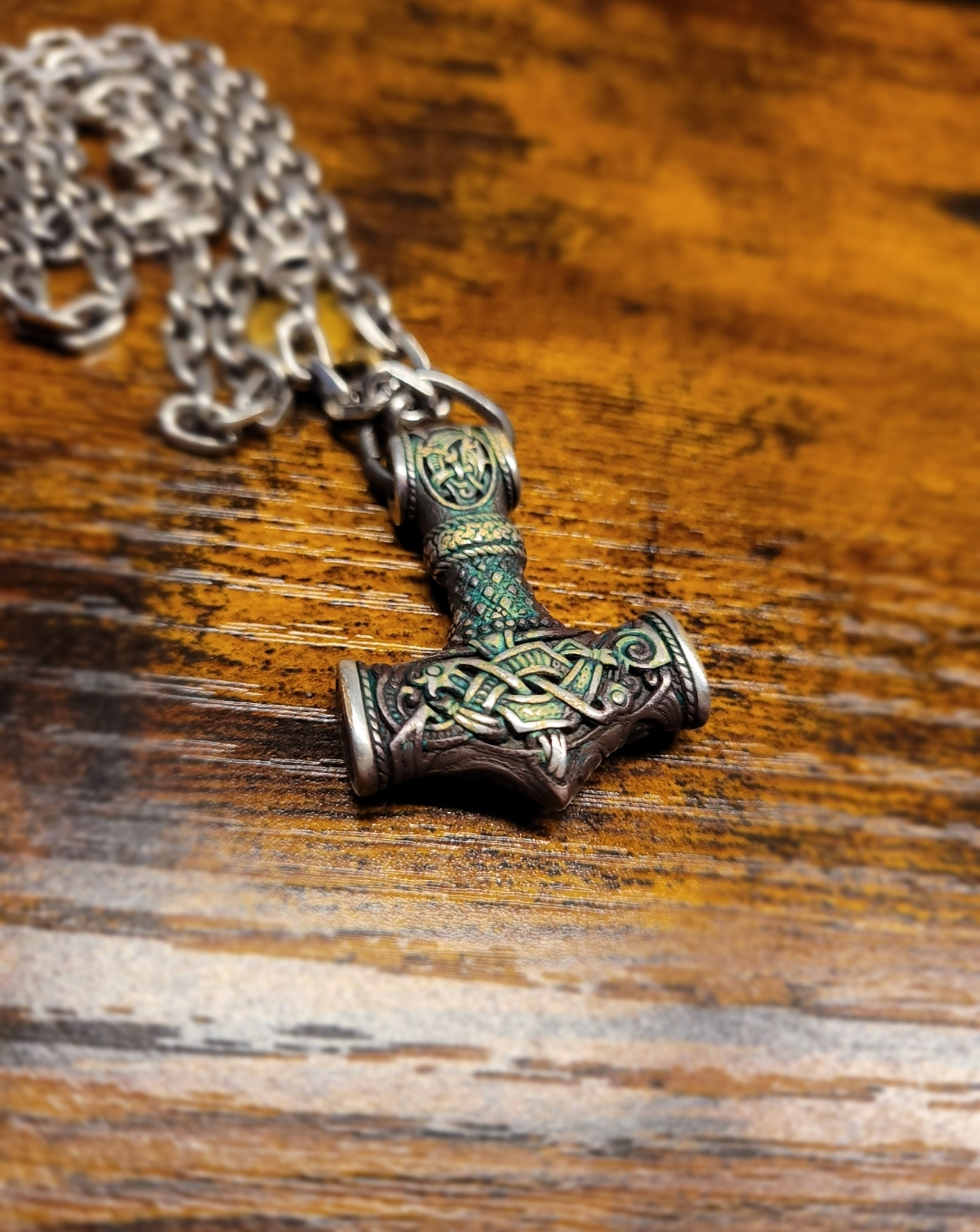
Mjölnir (Thor's Hammer)
Pronunciation: MYOHL-neer
Name and etymology
Mjölnir (Old Norse) is the hammer of Thor, god of thunder and defender of the gods. Where the word is derived from is debated: most often it is connected to a root meaning “to grind” or “to crush,” though it has also been linked to older words for lightning such as the Welsh mellt and Russian molniya; which would bind the weapon directly to the thunderclap Thor personifies.
Textual sources
Mjölnir appears across both major Eddic collections, set down in thirteenth-century Iceland roughly two centuries after conversion:
Its forging is told in the Skáldskaparmál, The Poetic Diction of the Skalds, of Snorri Sturluson’s Prose Edda. After Loki cuts off the hair of Thor’s wife Sif, he sets the dwarves to making treasures. This request in the form of a wager with the brothers Brokkr and Eitri (Sindri) yields three gifts for the gods, Sif’s new hair and thor’s hammer among them. Loki, realizing he may lose a wager for his head, takes on the shape of a fly, stings the dwarf working the bellows resulting in the hammer emerging from the forge with a short handle. This represented a single flaw in an otherwise perfect weapon. The gods ultimately judge it the finest of all the treasures precisely because it is their best defense against the giants.
Its properties are catalogued in the Gylfaginning, The Beguiling of Gylfi, of the same work, which lists Thor’s three great possessions: the hammer Mjölnir, the belt of strength Megingjǫrð, and the iron gloves Járngreipr needed to grip the hammer. There it is described as never failing to return to his hand when thrown, and as the thing the giants most dread to see raised against them.
Its theft and recovery drive the Eddic poem Þrymskviða,"The Lay of Thrym, in the Poetic Edda. The giant Thrym steals the hammer and demands the goddess Freyja in exchange for it’s return. Thor recovers it disguised as the bride. The poem preserves a key ritual detail, the hammer is brought out and laid in the bride’s lap to hallow the marriage, at which moment Thor seizes it and destroys the giants. It recurs elsewhere, notably in The Lay of Hymir, Hymiskvida, where Thor takes it up on his fishing expedition against Jǫrmungandr, the World Serpent.
Reading the symbol
Across these sources Thor’s hammer carries two functions a modern reader might expect to be separate, but which the Norse held as one in the same.
It is a weapon: The instrument by which Thor keeps the forces of chaos (the Jǫtnar) at bay and guards gods and humankind alike.
It is a consecrating tool: the object that sanctifies the central passages of life. The hallowing of the bride in Þrymskviða is the clearest textual instance; later sources and folk practice extend the blessing to births and funerals. In the mythology, protection and sanctification are not separate ideas. To hallow is to defend, and the same instrument does both.
A personal reading: the imperfect tool
An often glossed over but important aspect of the forging story deserves more weight than it usually receives. The hammer’s short handle is not incidental, it is chaos’s own mark on the weapon, left by Loki’s interference at the bellows before it was created. Yet when the gods render judgment, they name this flawed weapon the greatest of all the treasures that had been created. They saw it as the best defense of gods and Midgard against the forces of chaos. The imperfection did not disqualify the tool; the tool’s purpose and use were the only things of consequence. Chaos marred the hammer before and durring its making, and the hammer’s answer was to spend its existence holding chaos back.
I read this as a statement about character and overcomming the circumstances one is born into. Each of us is handed our own ørlög — the layer of circumstance, inheritance, and prior deeds laid down before and beneath us, the fate we inheret. We work that inheritance, choice by choice, into our wyrd, the pattern of fate our lives actually weave. Through right action over time we build our mægen, the store of personal might and worth that waxes and wanes with how we conduct ourselves and use the aquired wisdom, experience, and presence we build over a lifetime.
The hammer, Mjölnir. models the whole sequence. it did not choose it’s flaws, but wielded rightly, it became the shield of worlds, and the defender of gods. The measure of a person is not the circumstances they are born into; the chaos, personified in Loki, that touches every forging; but how they wield what they were handed to shape what they become. The gods’ verdict suggests they see each thing in existence exactly this way. They look beyond the shortcoming, to the true character and worth of the thing in front of them.
Historical and modern use
The symbol is well attested in the material record. Viking Age hammer pendants have been recovered across Scandinavia and beyond, worn as protective amulets, and they appear to grow more common during the conversion period. One surviving soapstone mold was cut to cast both Thor’s hammers and Christian crosses, a vivid trace of two symbols in direct competition.
That amulet tradition has carried forward largely unbroken. Worn at the throat, Mjölnir is still most often carried for protection; a guard against harm and a token of Thor’s strength and favor. This is same protective function the archaeology records, now a thousand years on. In modern Heathenry the pendant is frequently a devotional object, marking its wearer as under the Thor’s protection and worn much as it was in the Viking Age. For many others it is a cultural or aesthetic emblem of Norse heritage carried without a specific creed attached. Beyond the pendant, the hammer serves in contemporary Heathen practice to bless and mark sacred space, and it appears widely in jewelry, tattooing, and art.
← back to Symbols