The Web of Wyrd (Skuld's Net)
Pronunciation: The name is modern English. Wyrd is the Old English word. Our word “weird” descends from it, and pronouncing it that way is close enough. Cognate with Old Norse Urðr (OORTH-er). The three Norns: Urðr, Verðandi (VER-than-dee), and Skuld (SKULD).
Name and etymology
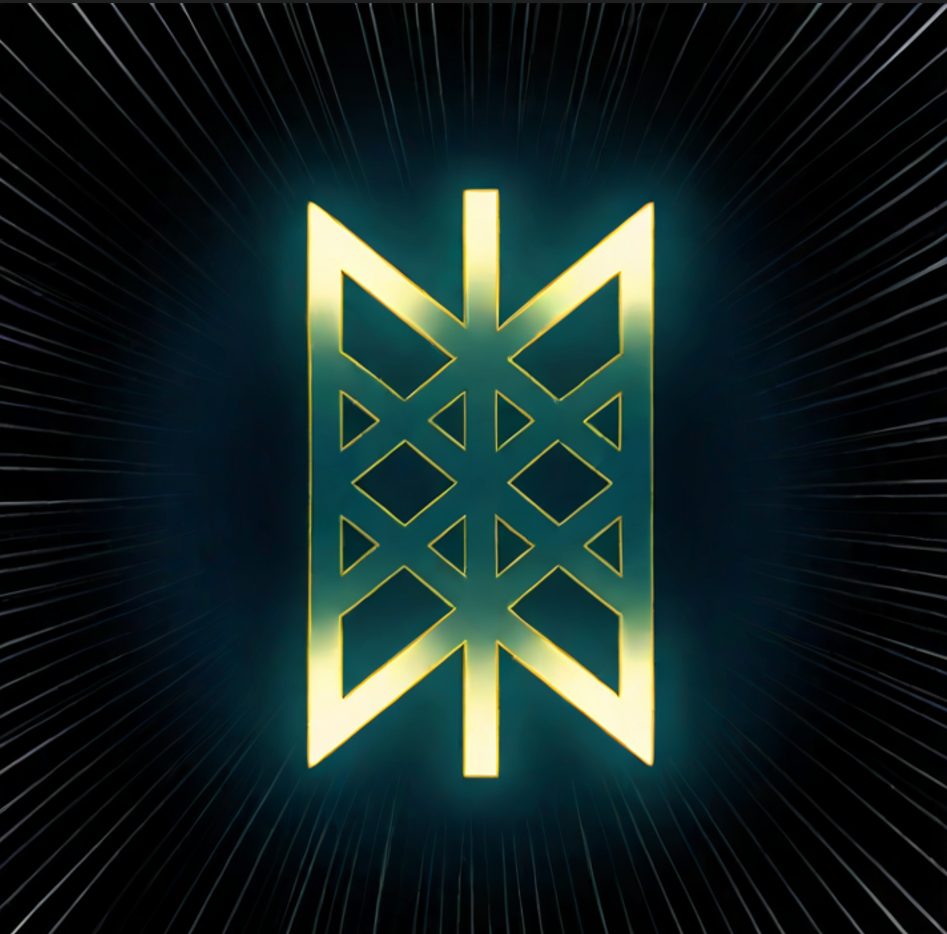
The Web of Wyrd, sometimes marketed as Skuld’s Net, is a lattice of nine staves, three sets of three, interwoven into a rectangular matrix. Its name borrows wyrd, the Old English cousin of Old Norse urðr: fate, or more precisely, what has come to pass. The accumulated weight of all that has happened, pressing its shape into what happens next. The Anglo-Saxons used the word with grim familiarity; wyrd goes ever as she shall, says Beowulf. That both branches of the old Germanic world carried this concept, in cognate words, tells you how deep in the tradition it runs.
The symbol itself has no historical attestation whatsoever. No runestone bears it. No Eddic manuscript contains it. It does not appear in the Galdrabók, the Huld Manuscript, or any of the Icelandic charm-books — the Troll Cross and Vegvísir are ancient by comparison. The nine-stave lattice is a creation of the modern rune revival, emerging from late twentieth-century esoteric literature, and “Skuld’s Net” is a modern coinage attached to it. The popular claim that accompanies it, that all the runes of the Elder Futhark can be traced within its lines, is a real geometric property of the lattice (angular staves at these orientations can compose any rune shape), but it is a property of the design, discovered in modern books, not a doctrine recovered from ancient ones.
So why does it earn an entry on this site at all? Because of what it diagrams. The Web of Wyrd is a wholly modern image of the tradition’s single oldest and most important idea; and held honestly, as a diagram rather than an artifact, it diagrams that idea rather well. In a living tradition, I choose to carry it as part of the evolution of the path as it depicts the concepts of fate quite well.
Textual sources: the concept the symbol illustrates
The doctrine of wyrd is as textually rich. Its seat is the Well of Urðr beneath Yggdrasil, where Völuspá places the three Norns: from the lake beneath the tree come three maidens, deep in knowledge — Urðr, Verðandi, and Skuld. They carve on wooden slips, lay down laws, and choose the lives and fates — the ørlög — of the children of men (st. 19–20). Everything alive gets its fate laid at that well, and the tree that holds the worlds is watered from the same water. Fate, in this cosmology, is not a decree from a throne. It is groundwater.
The Norns’ names deserve more care than the usual Past/Present/Future gloss, because the Old Norse does something sharper. Urðr comes from the past tense of verða, “to become”. She is That Which Became. Verðandi is the present participle of the same verb, That Which Is Becoming. And Skuld comes from skulu, “shall, must, owe”; the root that gives modern Scandinavian its word for debt. She is not “the future” as an open blank. She is That Which Shall Be; the obligation already accruing, the bill being written by what became and what is becoming. Hold onto that; it is the whole doctrine, and we’ll return to it shortly.
The web imagery itself, fate as something woven, is authentically Eddic. At the hero Helgi’s birth in Helgakviða Hundingsbana I, the Norns come in the night and twist the threads of his fate, stretching golden cords and fastening them under the sky, east, west, and north, the span of a life literally strung across the world (st. 3–4). Njáls saga preserves the tradition’s most terrifying loom-scene in the Darraðarljóð: before the great battle of Clontarf, a man peers into a hut and sees Valkyries weaving the web of war on a loom weighted with severed heads, threaded with entrails, beaten with swords, singing as they weave the fates of the armies, then tearing the finished cloth apart and riding away. Fate as textile is not a modern metaphor draped over the lore. It is the lore’s own recurring nightmare and masterpiece.
Add the Hávamál’s most famous stanzas — cattle die, kinsmen die, but the judgment on each life never dies (st. 76–77) — and the picture is complete: what you do becomes part of what became, and what became never stops shaping what comes. That is wyrd. The image of the lattice is new. The web imagery is not.
Reading the symbol
Read as a diagram, the nine staves carry the doctrine compactly. The vertical staves stand like warp-threads on a loom, the fixed strands already laid down. The crossing diagonals weave through them as present action passing through established pattern. Nine is the tradition’s number of completeness (nine worlds, nine nights on the tree, etc.), and the three-by-three structure echoes the three Norns, each holding a tense of the one process. The all-runes property, where you can trace each in the structure of the web, makes an honest point in the modern context. If every rune, every possibility, can be traced within the web, then nothing that happens falls outside the weave. Every letter of every story finds its shape inside the same lattice.
From this, the symbol’s modern meanings follow naturally. It stands as a symbol of fate with one’s actions as threads in a larger tapestry, connected backward and forward beyond what any single view can see. It serves as a mindfulness reminder that if present choices are threads that permanently join the weave, then choosing consciously matters at every scale. And it works as a meditative and divinatory tool for one to sit with when reflecting on one’s path. Which threads brought me here, which am I laying now, and what pattern am I making that I haven’t stepped back to see?
A personal reading: fate as debt, not script
Everything I want to say about this symbol lives in Skuld’s name.
We reflexively read the three Norns as Past, Present, and Future; and that reading quietly imports an assumption the Old Norse tradition never made. That the future is a place, already furnished, waiting for us to arrive. The third Norn is not named “Future.” She is named from the verb of obligation; she is Shall, she is Owed, she is the debt. That changes the entire doctrine. Wyrd is not a script written in advance that you act out helplessly. Wyrd is consequence. The compounding of everything that became and is becoming into what, therefore, shall be. The future isn’t written. It’s accruing. You are not living lines someone else wrote; you are servicing, and taking out, debts, every day, with every choice, into a ledger that began before you and will outlast you.
Sit with what that does to the fatalism question, because newcomers to this path may ask: if the Norns fix fate, why act well? The answer is in the grammar. What is fixed is the mechanism, that which became will shape that which becomes; conduct will compound; the weave will hold what you thread into it. What is not fixed is your thread. You arrive with ørlög laid down. The circumstances, inheritances, and prior deeds beneath you, debts you didn’t take out. Everything you weave from here joins the pattern permanently and changes what can be woven next, by you and by everyone whose threads cross yours. That is neither free-floating liberty nor helpless determinism. It is agency inside pattern; which, honestly, is just an accurate description of being alive. The old Northern mind looked at that condition without flinching and built its whole ethics on it. Since the weave keeps everything, weave well.
This is why I can carry a symbol invented in my own lifetime without embarrassment. The lattice is a modern diagram. It’s worth doesn’t hang on a fake pedigree any more than a map’s worth hangs on being as old as the territory. What it maps is the doctrine: the tended tree, the poured mead, the returned raven, the judgment that never dies, all of them are wyrd, seen from different angles. When I look at the nine staves, I see the ledger: every thread crossing threads already laid, every crossing permanent, the pattern growing outward past my sight. It does not tell me my future. It reminds me that I am, at this moment, weaving it — and that Skuld is keeping the books.
Historical and modern use
The symbol’s documented life belongs to the modern rune revival: it spread through esoteric rune literature in the late twentieth century and rode the same Norse-revival wave as Vegvísir into pendants, tattoos, and endless merchandise — where it is now routinely sold as an “ancient Viking symbol of fate,” a claim you are equipped to smile at. Its rise has one honest virtue the marketing lacks: the design became popular because the concept resonates. People encountering wyrd for the first time want something to hold, and a lattice of interwoven threads is a fair thing to hand them.
In modern practice the Web of Wyrd serves as a meditative focus for reflection on choice and consequence; as a rune-worker’s emblem, given the all-runes property; and in divination as a reminder of what a reading actually is on this path — not a fixed future retrieved, but the present weave examined: these are the threads as they lie, this is where the pattern points if the weaving continues as it goes. Some practitioners pair it with study of the Norns or keep it where decisions get made — the workbench, the desk, the door — in the same spirit as the old threshold-iron, though what this ward guards against is not trolls but thoughtlessness. Worn honestly, as the modern diagram it is, the Web of Wyrd is a powerful symbol, a picture of the one doctrine you will use every single day you walk this path. The weave keeps everything, so weave well.
← back to Symbols