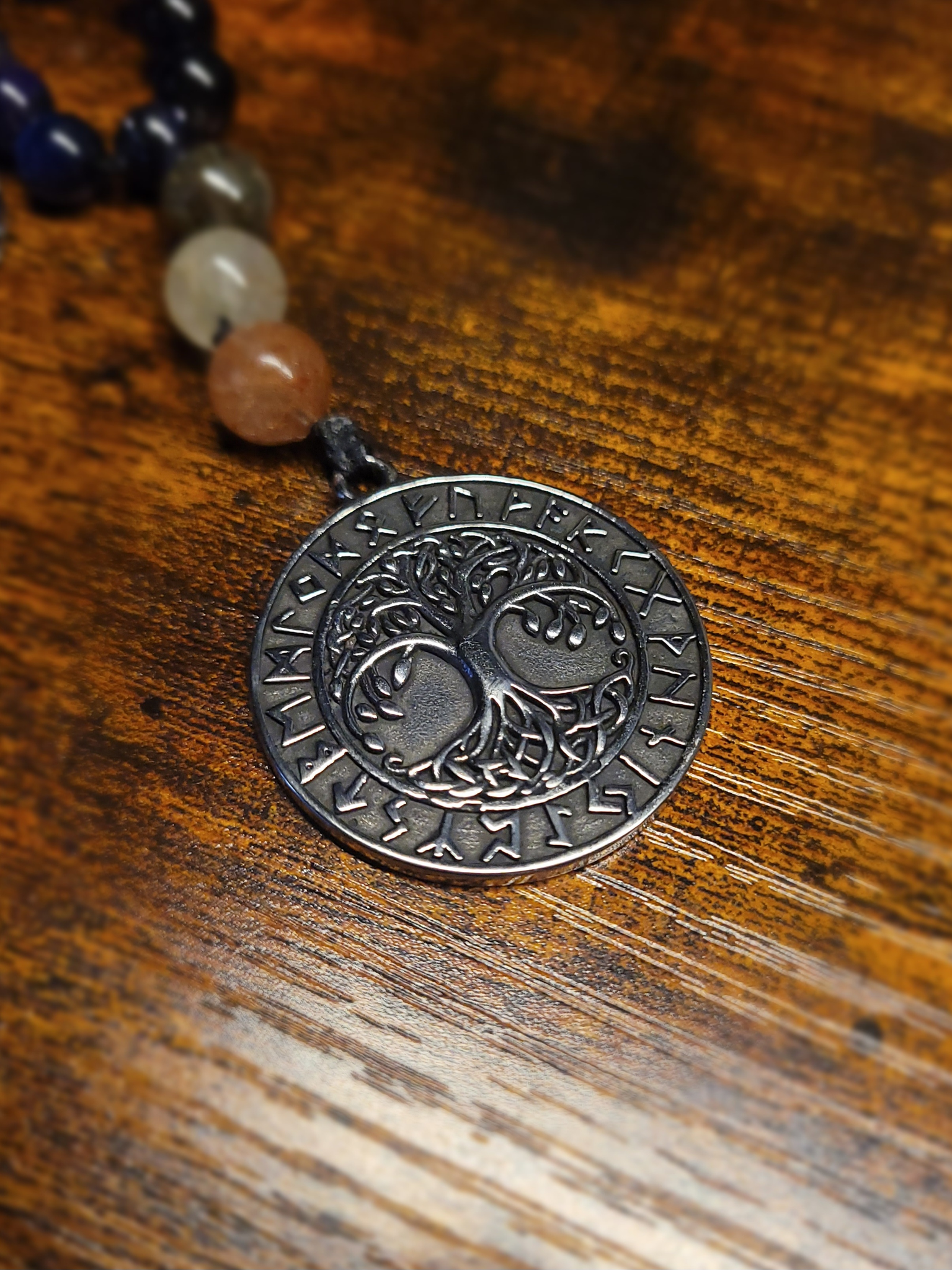
Yggdrasil (The World Tree)
Pronunciation: IGG-druh-sill
Name and etymology
Yggdrasill (Old Norse) is the great ash tree standing at the center of Norse cosmology, its roots and branches binding the worlds together. The name is most often read as “Ygg’s horse” — Yggr, “the Terrible One,” being a name of Odin, and drasill an old poetic word for horse. That reading is stranger and darker than it first sounds: in skaldic idiom the gallows was called the “horse” its victim rides, so the World Tree’s very name likely remembers the god who hanged himself upon it in search of wisdom. The tree that holds up the cosmos is named for the ordeal it hosted. Other derivations have been proposed, and as with much Old Norse etymology the question isn’t fully settled, but the gallows reading fits the poetry too well to ignore.
Textual sources
Yggdrasil stands throughout both Eddic collections, and unusually for a mythological object, the sources describe it not just as scenery but as a living thing with a biography.
The Völuspá gives it its cosmic frame. The seeress remembers nine worlds and the “glorious tree of fate” from before the earth was raised, and describes the ash in its established place: an evergreen standing over the Well of Urðr, where the three Norns — Urðr, Verðandi, and Skuld — shape the fates of all beings at its root (st. 19–20). At the poem’s far end, the tree marks the coming of Ragnarök in its own body: the old tree groans and shudders as the bonds break (st. 47). The World Tree frames the entire prophecy, present before the beginning and trembling at the end.
The Grímnismál supplies the richest catalog of the tree’s inhabitants and its suffering. Odin, speaking between the fires, describes three roots running in three directions — one over Hel, one over the frost-giants, one over humankind — and the traffic that runs along the trunk: the squirrel Ratatoskr scurrying up and down carrying the eagle’s words from the crown to the dragon Níðhöggr gnawing below (and, one assumes, sharpening the insults in transit); four stags — Dáinn, Dvalinn, Duneyrr, and Duraþrór — browsing its highest shoots; and more serpents lying beneath it “than any fool imagines.” The catalog ends on the poem’s most striking note: the ash Yggdrasil suffers agonies more than men know — the hart bites above, the sides rot, Níðhöggr tears beneath (st. 31–35).
The Gylfaginning, The Beguiling of Gylfi, in Snorri Sturluson’s Prose Edda systematizes the picture. Snorri arranges the three roots his own way — one among the Æsir at the Well of Urðr, one among the frost-giants at Mímir’s well of wisdom, one over Niflheim at the spring Hvergelmir where Níðhöggr chews the root from below — and adds the eagle in the crown with the hawk Veðrfölnir perched between its eyes. Most importantly, he records what keeps the tree alive: each day the Norns draw water from the Well of Urðr and pour it, with the well’s white clay, over the ash so that its branches will not rot or wither.
The Hávamál makes the tree the site of the tradition’s central mystery. Odin hangs nine nights on the “windswept tree” — wounded by his own spear, given to himself, with neither bread nor drink — to win the runes (st. 138–141). The poem does not name the tree outright, but the windswept gallows of the god called Yggr has never seriously been read as anything else.
The Nine Worlds
Yggdrasil connects the Nine Worlds of Norse cosmology, the realms of every order of being:
- Asgard — realm of the Æsir gods
- Vanaheim — realm of the Vanir gods
- Midgard — realm of humankind
- Jötunheim — realm of the giants
- Niflheim — realm of ice and mist
- Muspelheim — realm of fire
- Alfheim — realm of the light elves
- Svartalfheim — realm of the dwarves
- Helheim — realm of the dead
A note in the spirit of honesty about provenance: no surviving source lays out this list as a tidy enumeration. The poems and Snorri name these realms across many passages — Völuspá’s seeress remembers “nine worlds” without listing them, and the standard roster above is a modern reconstruction assembled from the scattered references. It’s a sound reconstruction, and I use it, but it belongs to the same category as every list on this site: a reader’s synthesis of the sources, not a quotation from them. Read the poems and count for yourself.
Reading the symbol
Across these sources, the World Tree carries two ideas a modern reader might expect to be separate, but which the lore holds as one.
It is structure: the axis and frame of everything. The Nine Worlds do not float free of one another; they are held in relation by the tree, connected by its roots and branches. Nothing in the cosmos is unconnected to anything else, and the connective tissue is alive.
It is process: a living thing in time, not a diagram. The tree grows, suffers, is fed upon, rots, and is renewed daily. Its well is the place where fate itself is laid down — the Norns shape ørlög at its root, and the same water that carries fate is what preserves the tree. In this cosmology, the deepest image of reality is not a throne or a fortress but a tree being tended: something organic, vulnerable, interdependent, and continuously becoming.
Modern readers find in Yggdrasil the meanings that follow naturally from that picture — interconnectedness, growth and renewal, balance among the parts of a life, and wisdom sought through understanding one’s place in a larger whole. None of those readings has to be forced onto the symbol. They are what the sources show, translated into modern vocabulary.
A personal reading: the tended tree
Here is the detail I keep returning to. The lore did not imagine an invulnerable cosmos. It imagined a wounded one — and then it imagined maintenance.
The stags eat the new growth. The sides rot. Níðhöggr never stops gnawing at the root. The Grímnismál says outright that the ash suffers more agony than men know. And the cosmos does not survive this because the tree is too mighty to fail. It survives because every single day, the Norns walk from the well with water and clay and tend it. The most important tree in existence — the one holding all the worlds together — is on a daily care schedule. Eternity, in this tradition, is not a property of the thing. It is a practice performed on the thing.
I read this as the lore’s quiet answer to a question every practitioner eventually asks: what actually keeps anything alive? A marriage, a friendship, a skill, a community, a tradition, your own character — none of these persists because it was built strong once. All of them are under constant attack from their own versions of the stags and the serpents: neglect, entropy, resentment, time. The things that last are not the invulnerable things. They are the tended things. The Hávamál says the same about friendship at human scale — the path to a good friend never grows over with grass, if you keep walking it (st. 119).
And the name of the tree adds the harder half of the lesson. Yggdrasil is where Odin hanged himself for wisdom; the structure that sustains all the worlds is also the site of the ordeal, the place where insight is paid for. The tree gives the cosmos its shape, and it costs something to everyone who truly engages with it — the Norns their daily labor, Odin his nine nights on the windswept gallows. What holds your world together will ask to be maintained, and now and then it will ask more than that. The lore’s counsel is not to resent either price. The alternative to the tended tree is the withered one.
Historical and modern use
Sacred and guardian trees are well attested in the Norse and broader Germanic world, and the World Tree of the poems almost certainly reflects living practice. Adam of Bremen, writing in the eleventh century, describes an immense evergreen tree standing beside the great temple at Uppsala, green in winter and summer alike, of a kind no one could name — an earthly Yggdrasil at the heart of the old religion’s most famous sanctuary. The Scandinavian farmstead tradition of the vårdträd, the warden-tree planted at the center of the homestead and treated with deep respect across generations, carried the same instinct down into recent centuries: a household with a living tree at its center, tended as the family’s own fate-anchor. Tree imagery on surviving textile fragments from the Viking Age and just after, most famously the Överhogdal tapestries, has long been interpreted by many scholars as Yggdrasil itself, though such readings remain debated as iconography from this period usually is.
In modern Heathenry, Yggdrasil serves as the shared map of the cosmos — the frame within which the Nine Worlds, the gods, and the practitioner all stand in relation. It appears constantly in art, jewelry, and tattooing, often rendered as a tree whose roots and branches interlace into a circle. For many, it carries a devotional or contemplative function: the realms of the tree offer a structure for meditation and journeying, and the image of the Norns at the well keeps the concepts of ørlög and wyrd rooted in something visual and concrete. And for a growing number of practitioners, the World Tree grounds an ethic of environmental stewardship — if the deepest picture of reality is a living tree that survives by being tended, then care for the living world isn’t an add-on to the path. It’s the path’s central image, taken seriously.
← back to Symbols